
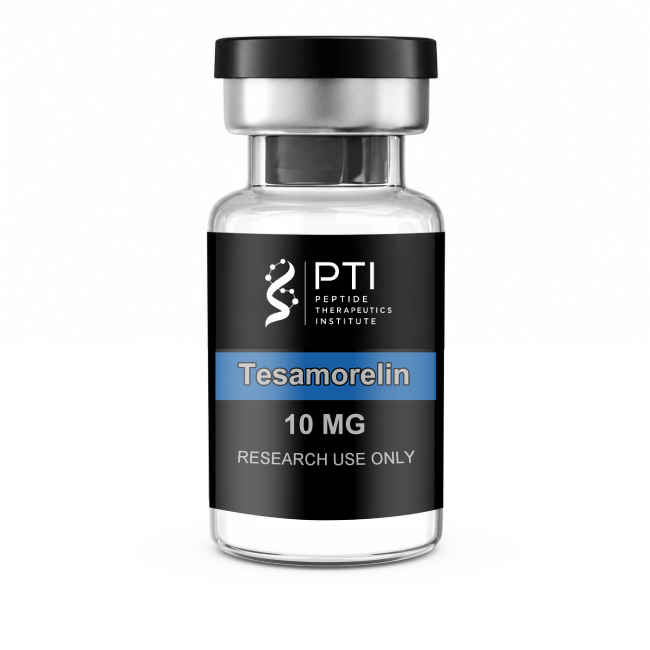
Tesamorelin 10MG
Description
Tesamorelin: A Synthetic Growth Hormone-Releasing Hormone (GHRH) Analog
Tesamorelin is a synthetic peptide analog of growth hormone-releasing hormone (GHRH), developed to stimulate the production and release of endogenous growth hormone (GH) from the pituitary gland. It consists of a 44-amino acid sequence that closely resembles natural GHRH but is modified to enhance stability and biological activity. Tesamorelin has gained attention in clinical and preclinical research for its targeted effects on the GH/IGF-1 axis, particularly in metabolic, endocrine, and age-related studies.
Its unique design allows for more efficient receptor binding while retaining a biochemical structure compatible with physiological pathways. Researchers value its role in increasing GH output in subjects with suppressed or dysregulated hormone levels. This analog has become increasingly useful in aging studies due to its ability to elevate GH while preserving rhythmic release patterns. Studies have explored how Tesamorelin influences IGF-1 production, collagen synthesis, and metabolic rate.
The molecule’s targeted function enables detailed exploration of GH’s influence on fat metabolism, protein turnover, and organ regeneration. Because of its stability, it is often selected for trials requiring extended durations or complex dosing protocols. Tesamorelin is also under investigation for its impact on neurological health, as GH and IGF-1 are known to support brain plasticity and cognition. Research continues to explore how it may be used in hormone therapy models, as well as its role in modulating immune and musculoskeletal health.
Mechanism of Action: Targeting the Pituitary for GH Secretion
Tesamorelin binds to GHRH receptors on somatotroph cells in the anterior pituitary, initiating a cascade of intracellular signaling that leads to increased GH secretion. This elevation in GH subsequently boosts insulin-like growth factor 1 (IGF-1) production in the liver and peripheral tissues. By mimicking the natural action of GHRH, Tesamorelin facilitates physiological patterns of GH release, making it a preferred compound for research that aims to maintain hormonal rhythms similar to those of the human body.
The compound triggers the cyclic AMP (cAMP) pathway, which activates protein kinase A (PKA) and other downstream effectors involved in GH gene transcription. Its receptor-specific action allows for precise analysis of GH’s downstream biological effects. Tesamorelin’s predictable response curve makes it an excellent candidate for studies that require repeated measurements of IGF-1 or GH pulse timing.
Researchers frequently use it to analyze dose-response relationships over short- and long-term windows. Its action supports metabolic studies by helping isolate the impact of GH on glucose regulation and lipid processing. The GH pulses induced by Tesamorelin more closely mirror physiological conditions than those elicited by older analogs. This property helps preserve receptor sensitivity over extended periods of administration. Researchers continue to utilize its mechanism to better understand pituitary function and hypothalamic-pituitary axis regulation.
Structural Stability and Bioavailability
Tesamorelin has a molecular weight of approximately 5 kDa and is designed to remain active in circulation long enough to induce clinically relevant increases in GH and IGF-1 levels. Its structural enhancements help prevent rapid breakdown by dipeptidyl peptidase-IV (DPP-IV), the enzyme responsible for degrading natural GHRH. This increased resistance extends the peptide’s half-life and enables more effective stimulation of GH over time without frequent administration.
The addition of a trans-3-hexenoic acid group at the N-terminus significantly improves its pharmacokinetic properties. These modifications support enhanced systemic exposure and allow for once-daily dosing in most models. Tesamorelin maintains high binding affinity even in low concentration environments, making it suitable for microdosing studies.
The structural resilience also allows researchers to maintain consistent GH levels without significant degradation during storage or transport. Because of its predictable half-life, it is commonly selected for time-controlled endocrine experiments. It shows high solubility and reconstitution stability, which supports its use in multi-phase trials. These traits make it a versatile peptide for a wide variety of delivery formats including injectable and implantable systems.
It is often evaluated alongside other analogs for comparative bioactivity in pharmacology screening trials. Tesamorelin’s optimized bioavailability also enhances its efficacy in chronic administration settings, ensuring reliable outcomes across research subjects.
Research Applications: Lipodystrophy, Metabolism, and Aging
Tesamorelin has been widely studied for its effects on body composition, especially in contexts involving lipodystrophy, visceral fat accumulation, and metabolic dysregulation. It has also been used in research focused on muscle preservation, glucose metabolism, and age-related decline in GH production.
The peptide has shown promise in studies on HIV-associated lipodystrophy, where altered fat distribution poses significant health risks. Additionally, Tesamorelin has been explored for its role in reducing liver fat and improving insulin sensitivity, further emphasizing its relevance in metabolic and endocrine research.
It is also under investigation for its role in combating sarcopenia and preserving lean body mass in older populations. In metabolic models, Tesamorelin is frequently used to observe changes in lipid oxidation and mitochondrial function. Its effectiveness in reducing visceral adipose tissue (VAT) makes it a central focus in studies related to central obesity and cardiometabolic risk.
Researchers have applied it in trials assessing the interaction between GH and hepatic lipid metabolism. Longitudinal research projects have also evaluated its ability to influence fasting glucose levels and glycogen storage. Ongoing studies continue to explore its utility in managing age-related hormonal decline, offering insights into quality of life improvements and biological resilience.
Research-Supported Benefits of Tesamorelin
Scientific studies have demonstrated several notable benefits of Tesamorelin in both clinical and experimental models. Research has shown that Tesamorelin effectively reduces visceral adipose tissue (VAT) without significantly affecting subcutaneous fat or lean muscle mass. This selective fat loss is particularly valuable in addressing central obesity and related cardiometabolic risks.
In individuals with HIV-associated lipodystrophy, Tesamorelin led to clinically significant reductions in VAT, improved lipid profiles, and enhanced quality of life. Additionally, studies indicate Tesamorelin may contribute to decreased liver fat and improved markers of hepatic function, suggesting broader metabolic benefits.
Researchers have also observed gains in aerobic capacity and improved insulin action in certain test populations. These outcomes suggest Tesamorelin may have applications beyond lipodystrophy in managing general metabolic imbalance. The peptide has shown promise in optimizing body composition during caloric restriction and structured training regimens.
Investigations into brain function have suggested potential cognitive improvements linked to increased IGF-1 levels. It is also being explored in research on cardiovascular risk mitigation due to its effect on cholesterol and triglyceride levels. Its consistent performance across different population groups makes it a valuable asset in ongoing hormone-related health studies.
Presented by Peptide Therapeutics Institute
Peptide Therapeutics Institute is committed to supporting advanced peptide research through high-quality research compounds and scientific innovation. Tesamorelin continues to be a leading focus in endocrine, metabolic, and longevity-related investigations, offering researchers a powerful tool for exploring the complexities of growth hormone regulation and metabolic health.
Reviews
There are no reviews yet.